 BubbleJournal
Air consumption (SAC rate): how to work it out and use it
By Dmitry Shalimov · Updated October 19, 2026
Your surface air consumption, or SAC rate, is how much gas you breathe a minute, converted to what it would be at the surface. Because it takes depth out of the picture, you can compare a shallow reef dive with a deep wall dive, track whether your breathing is getting calmer over the years, and plan how much gas your next dive needs.
What you need
- The tank's size: its water capacity in litres (such as 12 L), or its rated volume and pressure in imperial (such as 77.4 cu ft at 3000 psi for an aluminium 80).
- The tank pressure at the start and the end of the dive.
- The dive time, in minutes.
- The average depth. Your dive computer records it; the maximum depth gives a SAC that is too low.
The formula in metric
Gas used, in litres, is the pressure you used times the tank's size. Divide it by the dive time to get litres a minute at depth, then by the pressure at the average depth (the depth in metres divided by 10, plus 1) to bring it back to the surface:
SAC = (start bar − end bar) × tank litres ÷ minutes ÷ (average depth ÷ 10 + 1)
Example: a 12 L tank from 200 to 80 bar is 120 bar, or 1,440 litres. Over 45 minutes that is 32 litres a minute at depth. At an average depth of 12 m the pressure is 2.2 bar, so the SAC is 32 ÷ 2.2 = 14.5 L/min.
The formula in imperial
Imperial tanks are rated by the volume they hold when full, so take the share of the rated pressure you used:
SAC = (psi used ÷ rated psi × rated cu ft) ÷ minutes ÷ (average depth in feet ÷ 33 + 1)
Example: an aluminium 80 (77.4 cu ft at 3000 psi) from 3000 to 1000 psi is two thirds of it, 51.6 cu ft. Over 50 minutes at an average of 40 ft (2.21 atmospheres), the SAC is 51.6 ÷ 50 ÷ 2.21 = 0.47 cu ft/min.
A real dive, worked through
A dive from my own logbook, in Cenote El Pit: an aluminium 80 from 3000 to 600 psi, 51 minutes at an average of 43 ft. 2,400 psi of 3,000 is 64 cu ft. At 43 ft the pressure is 2.3 atmospheres, so the formula gives 64 ÷ 51 ÷ 2.3 = 0.55 cu ft/min.
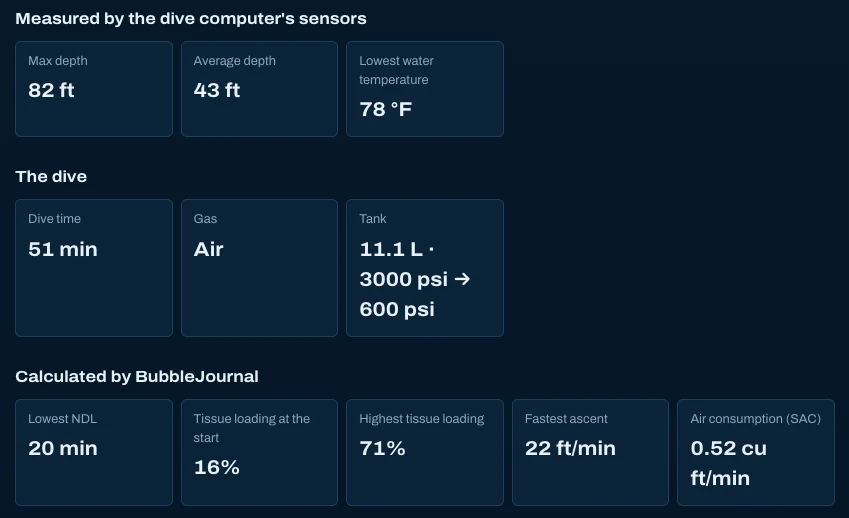
BubbleJournal shows 0.52, not 0.55. The formula treats air as a perfect gas, but at 3000 psi air is harder to squeeze than that, so a full tank holds about 5% less than its size times its pressure. BubbleJournal and Subsurface correct for it, which is why their SAC comes out a little below a hand calculation from a full tank.
Planning gas with it
Run the formula backwards: the gas a dive needs is your SAC times the pressure at the planned depth times the minutes.
Example: with a SAC of 15 L/min, 40 minutes at 18 m (2.8 bar) needs 15 × 2.8 × 40 = 1,680 litres. A 12 L tank at 200 bar holds about 2,400 litres; keeping 50 bar (600 litres) in reserve leaves 1,800, so the plan fits, but only just. Use a SAC from dives like the one you are planning: cold water, current or a heavy camera all raise it.
Why your SAC changes from dive to dive
- Work: swimming against current or finning hard can double it.
- Cold: the body burns more to keep warm.
- Buoyancy and trim: constant small corrections cost gas; good trim is one of the quickest ways to lower it.
- Stress and experience: new divers and divers in new conditions breathe faster.
- Leaks: a free-flowing octopus or a bubbling o-ring counts as breathing to the tank gauge.
One dive tells you little. The trend over many similar dives is what shows your breathing getting calmer, which is why it is worth logging tank pressures every time.
SAC, RMV and what your dive computer shows
Some divers and computers say RMV (respiratory minute volume) for the same litres-a-minute figure. Others give SAC in bar or psi a minute, which only compares dives on the same size of tank. Air-integrated computers with a transmitter record tank pressure through the dive and often calculate it for you.
In your logbook
BubbleJournal works out the SAC of every imported dive whose computer or file recorded tank pressures, and shows your average on the Stats page. Start a free logbook and import your dives to see yours.
More guides
- No-decompression limit (NDL): what it is and why it changes
- Tissue loading: what the percentage means and how it falls
- How to read a dive profile
Which dive computers BubbleJournal reads · Keep your dives in BubbleJournal, free