 BubbleJournal
Tissue loading: what the percentage means and how it falls
By Dmitry Shalimov · Updated October 19, 2026
Tissue loading is how full of nitrogen your body is, as a share of the most it can hold and still go straight up to the surface. 0% is a diver who hasn't dived for days. 100% is the no-decompression limit: at that point, a direct ascent is no longer safe. Many dive computers show it as a bar graph beside the NDL, and BubbleJournal works it out for every dive in your logbook.
Sixteen compartments, one number
Decompression models don't treat the body as one thing. Bühlmann ZHL-16C, the model BubbleJournal uses, splits it into 16 compartments that take up and give off nitrogen at different speeds. The fastest has a half-time of 4 minutes: halfway full, or halfway empty, in 4 minutes. The slowest has a half-time of over 10 hours.
Each compartment has its own limit, and the tissue loading is that of whichever compartment is closest to its limit, called the leading compartment. On a short deep dive it's one of the fast ones. On a long shallow dive, or by the end of a day of diving, the slow ones take over.
Tissue loading and your NDL
They are two views of the same thing. Your no-decompression limit is how many minutes are left before the leading compartment reaches 100% at your depth. Tissue loading is how much of the way there it already is. As you come shallower, the fast compartments start letting nitrogen go, the loading falls, and the NDL grows.
How it falls after a dive
Take a diver who hasn't dived for days, spending 45 minutes at 18 m (59 ft) on air: close to the limit, which is 55 minutes at that depth. This is how full the leading compartment is as they wait on the surface:
| Time | Tissue loading |
|---|---|
| Leaving the bottom | 93% |
| 30 minutes on the surface | 50% |
| 1 hour | 35% |
| 2 hours | 23% |
| 4 hours | 15% |
| 12 hours | 6% |
| 24 hours | 3% |
Bühlmann ZHL-16C, gradient factors 100/100, with no safety margin added. Don't plan a dive from this table: use your training, your computer and its settings.
It falls quickly at first, as the fast compartments empty, then more and more slowly, as the slow ones lead. A day later there is still a little left, which is why BubbleJournal carries the nitrogen from each dive over to the next until you have gone 72 hours without diving.
Repeat dives
A second dive starts where the surface interval left off. If the same diver goes back to 18 m an hour later, they start at 35%, and the same 45 minutes take them to 95%, past where the first dive got them. The leading compartment is a slower one by then, and the NDL on the second dive is shorter for it.
Nitrox
Nitrox 32 has less nitrogen than air, so the compartments fill more slowly. The same 45 minutes at 18 m take a fresh diver to 73% instead of 93%.
A real dive
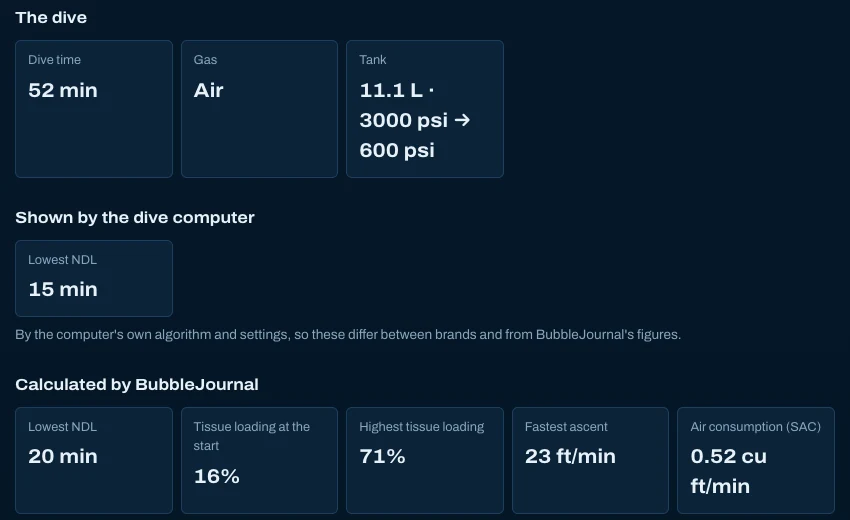
A cenote dive from my own logbook, at Cenote El Pit, to 82 ft for 52 minutes on air. It was a repeat dive, 1 hour 15 minutes after the one before, so it started at 16%. At its highest the tissue loading reached 71% of the limit, and BubbleJournal's lowest NDL for the dive was 20 minutes.
Why your computer shows a different number
Each maker uses its own model and margins. A computer set to gradient factors such as 40/85, or to a more conservative setting, reaches its 100% sooner, so its bar graph fills faster than BubbleJournal's. BubbleJournal works the loading out again, with one model, for every dive, so dives from different computers can be compared like for like.
In your logbook
BubbleJournal shows the tissue loading at the start of every dive with a depth profile and at its highest, carried over from your earlier dives, with nitrogen and helium worked out gas by gas. It's for your logbook only, never for planning a dive. Start a free logbook and import your dives to see yours.
More guides
- Air consumption (SAC rate): how to work it out and use it
- No-decompression limit (NDL): what it is and why it changes
- How to read a dive profile
Which dive computers BubbleJournal reads · Keep your dives in BubbleJournal, free