 BubbleJournal
No-decompression limit (NDL): what it is and why it changes
By Dmitry Shalimov · Updated October 19, 2026
Your no-decompression limit, or NDL, is how many more minutes you can stay at your depth and still swim straight up to the surface, at a safe ascent rate, without stopping on the way to let nitrogen out. Your dive computer counts it down through the dive. Stay past it and the computer asks for decompression stops instead.
What sets your NDL
- Depth: the deeper you are, the faster your body takes up nitrogen, and the shorter the limit.
- Time: every minute at depth uses some of it up, so the NDL falls through the dive and climbs again as you come shallower.
- Gas: nitrox has less nitrogen than air, so the same depth gives a longer limit.
- Earlier dives: nitrogen from a dive an hour or a day ago is still in your body, so a repeat dive starts with less to spend.
- The model and its settings: each computer works the limit out its own way, and a more conservative setting shortens it.
No-decompression limits by depth
These are the limits BubbleJournal works out for a diver who hasn't dived for days, going straight to the depth and staying there.
| Depth | Air | Nitrox 32 |
|---|---|---|
| 12 m (39 ft) | 181 min | 300+ min |
| 15 m (49 ft) | 90 min | 218 min |
| 18 m (59 ft) | 55 min | 107 min |
| 21 m (69 ft) | 36 min | 71 min |
| 24 m (79 ft) | 26 min | 45 min |
| 27 m (89 ft) | 19 min | 33 min |
| 30 m (98 ft) | 15 min | 25 min |
| 33 m (108 ft) | 12 min | 19 min |
| 36 m (118 ft) | 10 min | 15 min |
| 40 m (131 ft) | 8 min | 12 min |
Bühlmann ZHL-16C, gradient factors 100/100, with no safety margin added. Don't plan a dive from this table: use your training, your computer and its settings.
Why your computer and your logbook disagree
There is no single right NDL. Each maker uses its own decompression model and sets its own margins: Shearwater and Garmin use Bühlmann ZHL-16C with gradient factors you can choose, Suunto uses its own RGBM models, and Oceanic computers such as the Geo 4.0 offer Pelagic Z+ or DSAT. A conservatism setting, or gradient factors such as 40/85 instead of 100/100, shortens every limit.
That is why BubbleJournal works the NDL out again, with one model, for every dive, and keeps it apart from what your computer showed. Dives from a Shearwater, a Suunto and an Oceanic can then be compared like for like.
Repeat dives
After a dive your body keeps letting nitrogen out for hours: some of it is gone within the first hour, the slowest of it takes a day or more. A second dive the same day starts with some still in, so its NDL is shorter at the same depth. BubbleJournal carries the nitrogen from each dive over to the next, through the surface interval between them, until you have gone 72 hours without diving. That is why it needs your earlier dives, in order, to get a dive's NDL right.
A real dive
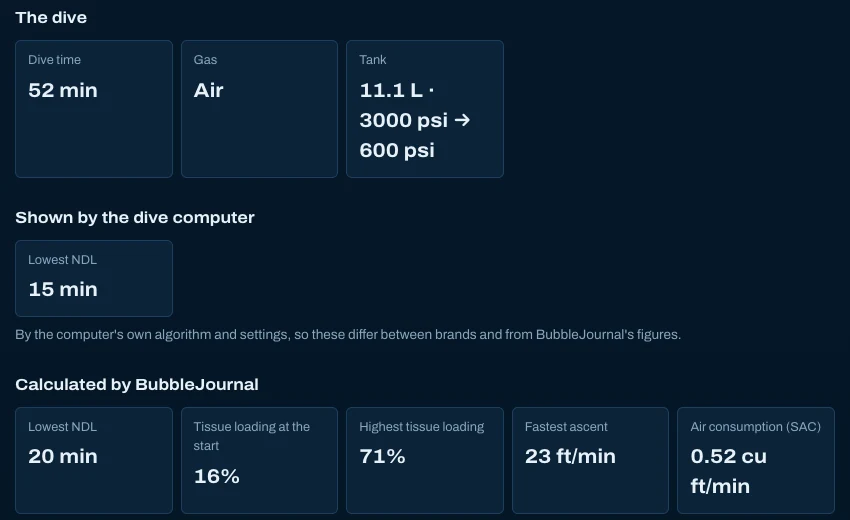
A cenote dive from my own logbook, at Cenote El Pit, to 82 ft for 52 minutes on air. It was a repeat dive, 1 hour 15 minutes after the one before, so it started with 16% tissue loading already in. My Oceanic Geo 4.0 showed a lowest NDL of 15 minutes, by its own algorithm and settings. BubbleJournal works out 20 minutes for the same profile: the five minutes between them come from the computer's own model and the margin it keeps, where gradient factors 100/100 keep none. At its highest the tissue loading reached 71% of the limit, well inside it all the way.
Going past it
Stay past the NDL and a direct ascent is no longer safe: the computer shows a ceiling or a stop to wait at before going shallower. Recreational training keeps you inside the limit, with a safety stop at around 5 m (15 ft) at the end of every dive. If a dive in your logbook went past it, BubbleJournal says so on the dive.
In your logbook
BubbleJournal shows the lowest NDL and the tissue loading of every dive with a depth profile, worked out the same way whichever computer recorded it. It's for your logbook only, never for planning a dive. Start a free logbook and import your dives to see yours.
More guides
- Air consumption (SAC rate): how to work it out and use it
- Tissue loading: what the percentage means and how it falls
- How to read a dive profile
Which dive computers BubbleJournal reads · Keep your dives in BubbleJournal, free